Premier League
VAR Controversy Returns As Dalot Red Card Debate Exposes Premier League Refereeing Divide
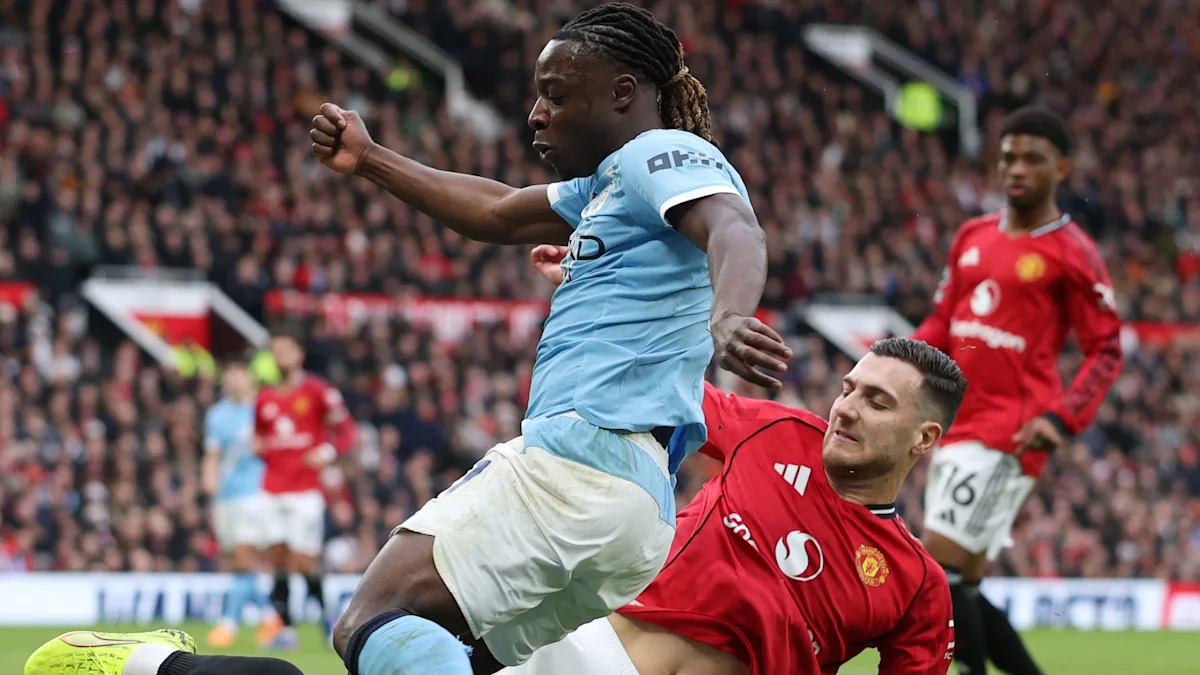
Pep Guardiola may have sounded magnanimous after Manchester City’s disappointing derby defeat at Old Trafford, but deep down, the City boss will surely feel the game could have unfolded very differently.
The flashpoint came just 10 minutes in, with the score still goalless, when Diogo Dalot lunged in on Jeremy Doku near the touchline. The Manchester United defender stretched to intercept the ball but caught Doku with his studs on the knee—a moment that instantly divided opinion.
Referee Anthony Taylor showed a yellow card. VAR official Craig Pawson reviewed the incident and backed the on-field decision, describing the contact as “glancing and not with excessive force.” That explanation, however, failed to convince much of the football world.
Former Players Cry Foul
The court of public opinion reacted swiftly—and harshly. Among the loudest critics was former England striker Alan Shearer, who did not mince his words.
“I think VAR got that terribly wrong. For me that was a clear red card,” Shearer told BBC Sport.
“It should have been a very easy decision.”
Shearer acknowledged the referee might have missed key details in real time, but questioned how VAR officials failed to intervene after reviewing multiple angles.
Premier League Vs Europe: A Philosophical Gap
At the heart of the controversy lies a wider issue: the Premier League’s tolerance for physicality.
Professional Game Match Officials Limited (PGMO) remain comfortable with the yellow card, arguing that slow-motion replays exaggerate the force of challenges. From their perspective, viewed at normal speed, Dalot’s tackle lacked the excessive force required for a red card.
Yet therein lies the problem. In a Champions League fixture, UEFA guidelines would almost certainly demand a dismissal. The same challenge, interpreted differently depending on the competition, exposes a glaring inconsistency in football’s disciplinary standards.
The Premier League prides itself on being fast, physical, and intense—but that identity creates grey areas, particularly around serious foul play.
VAR’s Growing Red Card Problem
Last season highlighted VAR’s struggle to strike the right balance. The Premier League’s Key Match Incidents Panel recorded seven serious foul play errors—its highest ever tally.
Three red cards were missed entirely. Two red cards were wrongly issued after VAR reviews. Four players, including Bruno Fernandes and Christian Norgaard, had red cards overturned on appeal. Ironically, all this undermines VAR’s original purpose: to reduce clear and obvious errors.
This season, there have been no serious foul play errors logged so far—but the Dalot incident threatens to reopen that debate.
A Familiar Pattern: Sarr And Jones Comparisons
The Dalot challenge bears similarities to Pape Matar Sarr’s controversial tackle against Chelsea last season—also officiated by Pawson. In that incident, studs made contact with the knee, the opponent’s leg buckled, yet only a yellow card was issued after VAR review.
PGMO later defended the decision, emphasizing “glancing contact” and lack of prolonged force.
Compare that with Curtis Jones’ red card against Tottenham in 2023—where initial contact was followed by continued force through the leg—and the inconsistency becomes difficult to justify.
Dalot’s straight leg and studs-up contact suggest greater danger, making the “glancing” argument a tough sell for many observers.
A Decision That Will Linger
Ultimately, VAR’s scope is limited by how referees describe incidents during reviews. If Anthony Taylor acknowledged studs-on-knee contact and judged the force himself, VAR’s hands were largely tied.
Still, football fans are left asking the same question once again: when does physicality cross the line into endangerment?
For many, this one already did.
Want to advertise with us? Contact sales@ventolitemarketing.com




Marc Skinner Backs Manchester United To Stage Bayern Comeback Despite First-Leg Setback

U-13 JOF Kids Cup: Teams Eye Q/Final Slots As Round Of 16 Matches Hold This Weekend

Antonio Rudiger Fires Back At Critics After Getafe Incident Sparks Controversy

Sampdoria Power Struggle Deepens As Mancini And Fredberg Clash Over Club Direction

Enzo Fernández Fuels Real Madrid Speculation With Cryptic Chelsea Future Comments

Wayne Rooney Questions Tuchel’s England Call As Trent Snub Sparks ‘Clique’ Controversy
-

 LaLiga2 days ago
Antonio Rudiger Fires Back At Critics After Getafe Incident Sparks Controversy
-
 Premier League3 days ago
Wayne Rooney Questions Tuchel’s England Call As Trent Snub Sparks ‘Clique’ Controversy
-
Transfers2 days ago
Enzo Fernández Fuels Real Madrid Speculation With Cryptic Chelsea Future Comments
-
News2 days ago
Sampdoria Power Struggle Deepens As Mancini And Fredberg Clash Over Club Direction
-
News1 day ago
U-13 JOF Kids Cup: Teams Eye Q/Final Slots As Round Of 16 Matches Hold This Weekend
-
CHAMPIONS LEAGUE2 hours ago
Marc Skinner Backs Manchester United To Stage Bayern Comeback Despite First-Leg Setback