
European Leagues
Uzbekistan host 10th FIFA Futsal World Cup as France set for debut
The 10th FIFA Futsal World Championship in Uzbekistan will feature 24 teams, with Afghanistan, Tajikistan, New Zealand, and France making their debuts, and Portugal returning to defend their title won three years ago in Lithuania.
The first-ever FIFA tournament in Central Asia kicks off on 14 September in Bukhara and the capital, Tashkent. The eastern city of Andijan will complete the trio of venues for the 24-team competition. The 2024 edition will be the tenth in the history of the FIFA Futsal World Cup and will run until 6 October.
Futsal has grown rapidly in Uzbekistan over the past decade. The White Wolves made their debut at the FIFA Futsal World Cup in 2016 and reached the knockout stage in 2021, losing 9-8 to IR Iran in the Round of 16 in one of the most exciting matches in the tournament’s history.
Uzbekistan will be joined in the competition by four former champions – Argentina, Brazil, Portugal and Spain – and four debutants: Afghanistan, France, New Zealand and Tajikistan. Angola, Costa Rica, Croatia, Cuba, Guatemala, Iran, Kazakhstan, Libya, Morocco, Netherlands, Panama, Paraguay, Thailand, Ukraine and Venezuela complete the line-up after successfully completing the 121-team qualifying process.
First-ever FIFA Futsal Ranking
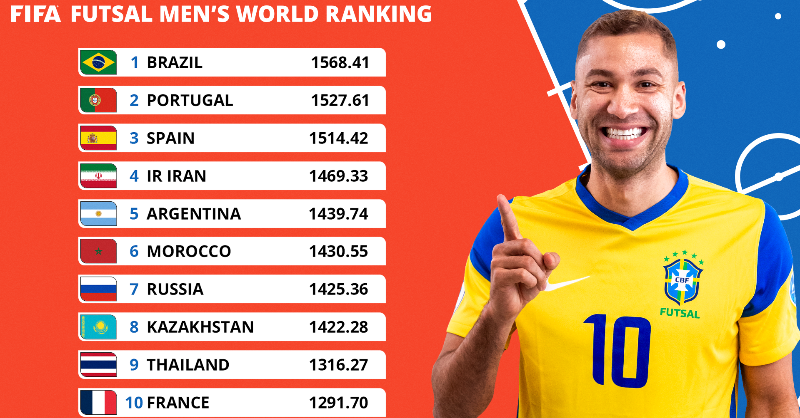
Earlier this year, the first FIFA Futsal World Ranking was published for both men and women. The top six teams – Brazil, Portugal, Spain, Iran, Argentina and Morocco – will compete for the title in Uzbekistan. The launch of the qualifiers was an important milestone and strengthened the position of futsal.
Hosts Uzbekistan, the Netherlands, Paraguay and Costa Rica will compete in one of the most open groups in the history of the FIFA Futsal World Championship, while three reigning continental champions – Portugal, Panama and Morocco – will join Tajikistan in the first round.
In Group D, defending champions Spain and Kazakhstan are joined by New Zealand and newcomers Libya. Five-time champions Brazil share a group with Cuba, Croatia and up-and-coming Thailand. Afghanistan, making their first FIFA appearance since 1948, are paired with 2016 champions Argentina, Ukraine and Angola.
A clash of titans and new rivalries
Brazil and Spain won the first seven editions of the FIFA Futsal World Championship, five and two times respectively. Argentina and Portugal have since added their names to the trophy. Several emerging powers are threatening to do the same at this year’s event, which kicks off on 14 September.
Afghanistan, France, New Zealand and Tajikistan will be making their tournament debuts, while Croatia and the Netherlands will be returning for the first time in almost a quarter of a century.
Superstars to watch
A total of 336 players will be competing for the FIFA Futsal World Cup trophy in Uzbekistan, with megastars in abundance. FC Barcelona’s Ferrao and Sergio Lozano have both overcome serious injuries.
The Brazilian pivot has been called up by Marquinhos Xavier despite his limited involvement over the past 18 months, while Sergio Lozano’s resilience has seen him recover from a fourth anterior cruciate ligament operation on his right knee.
Spain have an interesting mix of experience and youth, with plenty of quality. As well as three outstanding goalkeepers, they have the likes of Tomaz, Cortés, Adolfito, Catela and Miguel Ángel Mellado.
As well as Ferrao, a three-time World Player of the Year, Brazil also boast Pito, considered by many to be the best player in the world at the moment. Marquinhos’ group is also blessed with the outstanding and experienced professionals Guitta, Marlon and Dyego.
Ten of the men who helped Portugal defeat Lithuania in 2021 will be present. In their first World Cup without the legendary Ricardinho for 20 years, Jorge Braz’s side boast three of the world’s best players in Erick Mendonca, Pany Varela and Zicky, as well as 21-year-old phenom Kutchy.
Cristian Borruto, Alan Brandi, Nico Sarmiento, Pablo Taborda and Kiki Vaporaki, who helped Argentina triumph at Colombia 2016, will be aiming for a second gold medal. Angel Claudino, who scored a stunning goal in the 2-1 defeat to Portugal in the 2021 final, is another key figure for coach Matias Lucuix.
A tournament full of milestones and historic moments
The rest of the top ten in the FIFA Futsal World Ranking also include Moslem Oladghobad and Hossein Tayyebi (IR Iran), Soufian Charraoui and Soufiane El-Mesrar (Morocco), Douglas Junior and Leo Higuita (Kazakhstan), Muhammad Osamanmusa and Suphawut Thueanklang (Thailand) and Abdessamad Mohammed and Souheil Mouhoudine (France).
In a testament to the scale of Uzbekistan 2024, Kritsada Wongkaeo recently quit professional football to play in his fourth FIFA Futsal World Cup. Despite not having much time to prove his worth, the 36-year-old has done enough to win over Thailand coach Miguel Rodrigo.
Uzbekistan, ranked 11th in the world, are determined to repay their passionate fans in what they know will be an electric atmosphere. Ilkhomjon Khamroev, Khusniddin Nishonov and Ikhtiyor Ropiev have the class to make it happen, while 19-year-old Fazliddin Botirov is a promising prospect.
Croatian icons Dario Marinovic and Franko Jelovcic, who have enjoyed admirable club careers, will finally be playing on futsal’s biggest stage at the age of 34 and 33 respectively, while New Zealand captain Dylan Manickum will be making history by playing in his second FIFA tournament. The 32-year-old represented Auckland City at the last two FIFA Club World Cups and will join Fabinho, N’Golo Kante and Karim Benzema in Saudi Arabia 2023.
Afghanistan, who will be making their first FIFA appearance since 1948, are banking on youth. Incredibly, four of the eight players who will take part in the tournament are teenagers: Mehran Gholami, Bahman Gorgej, Ali Jafari and Mohammad Moradi.
Other magicians to watch out for include Ayoub Boukhari (Netherlands), Minor Cabalceta (Costa Rica), Wilmer Cabarcas (Venezuela), Helber (Angola), Jonathan Hernández (Cuba), Igor Korsun (Ukraine), Alfonso Maquensi (Panama), Damián Mareco (Paraguay), Dilshod Salomov (Tajikistan), Marvin Sandoval (Guatemala) and Ali Shoshan (Libya).
The tournament promises to showcase the very best of futsal, from seasoned champions to exciting newcomers. With a host of superstars, historic debuts and thrilling matches to come, the stage is set for one of the most memorable FIFA Futsal World Cups in history.
Groups
Group A: Uzbekistan, Netherlands, Paraguay, Costa Rica
Group B: Brazil, Cuba, Croatia, Thailand
Group C: Argentina, Ukraine, Afghanistan, Angola
Group D: Spain, Kazakhstan, New Zealand, Libya
Group E: Portugal, Panama, Tajikistan, Morocco
Group F: IR Iran, Venezuela, Guatemala, France



-

 Premier League3 days ago
Danny Murphy Warns Liverpool Over Defensive Transfer Problem
-
European Leagues3 days ago
Southampton Face Fresh Spygate Hearing as Tonda Eckert Is Charged
-
Premier League3 days ago
Jadon Sancho Faces Key Questions After Manchester United Exit
-
Uncategorized1 day ago
Vox Casino obsługa klienta – pomoc i wsparcie w online casino
-
Uncategorized1 day ago
Cleobetra Casino Canada – Slots and Other Casino Games
-
Uncategorized2 days ago
SpinGreen kasyno online Polska – wpłaty, wypłaty i płatności
-
Uncategorized1 day ago
Onlayn Kazino Pin Up Azərbaycanda – Giriş və Oynama
-
Uncategorized1 day ago
Олимп Казино – Получай BONUS 100% + 250 бесплатных вращений