More Sports
Becky Zerlentes – The First female Boxer To Die In Fight In US
Warning: This article contains details readers may find distressing.
April 3, 2005. It’s 02:00 in Washington.
Stephan Weiler is woken by a “dreaded call”. A voice said: “Is Becky Zerlentes your wife?’
“I said ‘yes’, and the official from Denver Health Medical Center and Hospital told me I need to get to the airport as quickly as possible. Her condition was deteriorating.”
Up until that day, a female boxer in the United States had never died in a sanctioned fight.
In succumbing to that devastating blow, Zerlentes – who three years previously won a regional boxing title – had rewritten history.
While the tales of fighters like Johnny Owen and Jimmy Doyle, external are enshrined in history, the impact of Zerlentes’ death on the community in Denver and on those who loved her has remained private.
Zerlentes’ love affair with combat sports defined her life, an overwhelming rush every time she stepped inside the confines of a boxing ring or MMA cage.
Like most amateur fighters, 34-year-old Zerlentes embraced a career away from the ropes, working as a geography and economics professor at Front Range Community College’s Larimer County campus, earning a master’s and PhD.
The buzz she enjoyed inside the classroom was complemented by her love of sport, especially in combat.
On that fight night, Weiler remained in the capital of the US, continuing his three-year stay at the Federal Reserve, the country’s central banking system.
He had constantly been asked by Zerlentes to return to Fort Collins, the former military outpost nestled in the foothills of the Rocky Mountains, and promised he soon would.
Facing Heather Schmitz, Zerlentes was taking part in the Colorado State Boxing Senior Female Championships at the Denver Coliseum in Colorado, a venue that has crammed more than 10,000 people in when the Rolling Stones or Rage Against the Machine have been in town. Both women wore protective headgear.
For two rounds Zerlentes worked, trading punches with Schmitz until the third.
With a blow to the head, just above her left eye, Zerlentes staggered forward, struck the canvas and fell unconscious – a state she would remain in until her death the following morning.
“The doctor in the ring said her pupils were fixed and dilated when he saw her first and already there was a chance that brain damage had occurred,” Weiler, now a professor, said.
By 06:30 Weiler was on a flight to Denver and immediately made his way to the hospital. There he saw Zerlentes.
“The amount of damage to Becky’s brain was remarkable given that it was a fairly glancing blow,” he said.
“It was not a hard hit… but the brain had become bruised to such an extent that it could no longer operate.”
The life support Zerlentes had been placed on was beginning to fail, and that “clinically she was probably already dead in the ring”, Weiler recalled.
And then he had to make a choice.
“At about noon that morning, the decision was made, knowing that her condition was deteriorating, I made the choice that it was time,” he said.
The reaction to her death was immediate.
Tributes flooded in across Denver. Colleagues, students and others who knew Zerlentes described the warmth and tenacity of one of the college and community’s pillars.
But soon the circus arrived in town.
“I actually avoided my house because there was a Clint Eastwood movie, Million Dollar Baby, about a woman boxer, and it had just opened and was very popular when Becky died,” Weiler said.
“They have a sort of hideaway hotel at the hospital and I just didn’t want [to talk]. I mean the issue was sensationalised enough and I had no desire to feed that.”
For 10 days, Weiler kept away from his home until the reporters got tired of waiting.
And so, bar one interview with the local newspaper, owing to Zerlentes’ commitment to the community, Weiler went quiet.
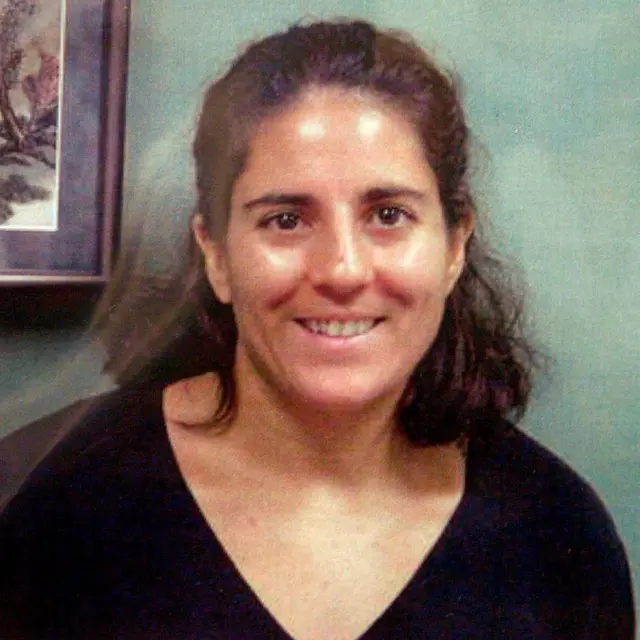
Zerlentes was a geography and economics professor as well as a keen fighter
He did not return to Fort Collins for 15 months and did not go home until he was “ready to handle the ghosts” that remained there.
Elsewhere, as the long days sank in for Weiler, Heather Schmitz was facing a battle of her own.
Since her blow was responsible for the death of Zerlentes, the 20-something Schmitz was now being interviewed in relation to a homicide case by police in Denver.
Schmitz, despite the ongoing investigation, reached out to Weiler. He described her tears and apologies, which he accepted, reminding the young woman that she had not meant to kill Zerlentes. The case against Schmitz was eventually dropped.
In the hope of warning others about the impact boxing can have, Weiler has now decided to speak about his experience.
“It’s the most male bloodlust sport,” he said.
“And that’s the only way you can talk about mixed martial arts for instance, which didn’t really exist at the time. There’s betting based completely on battering your opponent.
“I mean, it’s one thing to do that in ping pong or table tennis – it’s another thing when you’re talking about somebody’s life.”
Coming to terms with his grief has been a journey travelled with friends and family, but no-one who knows what he has experienced first hand – until recently.
September 11, 2015. It’s about 1am in Sydney.
Davey Browne Jr is in hospital.
“They said if we open up his skull he would just bleed out. I made a noise that I have never made before and I have never made since. This animalistic noise. I just needed to see him.”
This is Amy Lavelle, who, like Weiler, lost her partner to boxing.
Just an hour ago, Lavelle’s husband was minutes away – his corner believed – from a points win over super-featherweight rival Carlo Magali, a Filipino fighter nicknamed ‘The Ferocious’, at Ingleburn RSL club in Sydney.
Barely 30 seconds were left in the 12th and final round.
Then, disaster. The 28-year-old father of two went down – it was a knockout. Initially, he rose from the canvas but moments later collapsed on his stool.
By the early hours, it was clear Browne was not going to make it. Lavelle, looking at her unconscious husband, saw her world crash around her.
She said: “I just thought, how can the boys grow up without their father? How can this happen? I can’t imagine them growing up without knowing him. It was unfathomable. It was just a total nightmare, a true nightmare.”
Before meeting Lavelle, Weiler had not had any contact with the authorities, promoters or managers for years.
United in grief and now friends, Lavelle and Weiler seek solace in each other’s shared experience. And they also agree, when it comes to support in the aftermath of this form of trauma, there has been none.
Within the first few days, both were contacted by a handful of people. There is no single governing body in the world that oversees boxing, whether to set standards or uphold them. Professional fights are overseen by the area’s individual commissions.
At the time of Zerlentes’ fight, amateur US boxing bouts were sanctioned by USA Boxing, while Browne’s was sanctioned by the IBF but overseen by the Combat Sports Authority in Australia.
The IBF and USA Boxing did not respond to requests for comment on this story.
An inquest into Browne’s death raised serious issues about governance, mandatory training for those at ringside, and those at ringside’s ability to recognise serious head injury and their confidence to intervene.
But ultimately, there has been silence from those wandering the corridors of boxing power.
“Which is kind of interesting,” Weiler said. “I mean it was so public for a while. I’d be happy to talk but I haven’t heard from anyone.”
If it was down to Weiler, he would be telling every up-and-coming fighter, whether they are making their pro debut or just starting out on the pads, to thoroughly think it through before taking that first step.
“The workout is great,” Weiler continued. “But please think twice about having them participate in the competitive part of it.”
The situation with youngsters and long-term health implications is an obvious issue in American football. In 2016, a group of retired players who had suffered brain damage received a $1bn (£700m) settlement from the NFL.
With huge collisions occurring regularly throughout matches, the sport’s links to brain trauma and associated conditions are becoming more substantial. The NFL reported a 17% decrease in concussions in the 2024 season but studies suggest just three concussions can have a lasting impact.
Boxers deal with similar trauma. World title challenger Heather Hardy was forced to retire last year because she was suffering from severe symptoms of chronic traumatic encephalopathy (CTE).
CTE is a brain condition linked to repeated blows to the head and concussion. The condition, which gradually gets worse over time and leads to dementia, can only be diagnosed post-mortem.
In February, Irishman John Cooney died because of injuries he sustained in a boxing fight in Belfast.
“The wealth these guys [American football and boxing stars] accumulate is extraordinary. But is it worth a lifetime of dementia and depression and suicidal thoughts?” Weiler said.
“I guess everyone should make that call themselves, but they should be making that call fully aware of what the risks are.”
Lavelle agrees.
“While it’s sad, it’s not all totally uncomfortable, because it’s my reality,” she said.
“There needs to be some education for the athletes coming in so they know about the risks – so they are more aware of what they’re getting themselves into.
“I don’t think that’s done. It’s all just bravado and toughness.”
Bbc.com




7th U-13 JOF Kids Cup: Teams Record Victories As Preliminary Round Hots Up Across Centres

Iwobi Warns Liverpool: “Osimhen Airways” Ready for Takeoff at Anfield

Senegal Take CAF to Court Over “Unacceptable” AFCON Title Decision

CAF’s AFCON Title Decision Sparks Legal Controversy Over Laws of the Game

TRIBUTE: Goodbye Henry Nwosu

Thierry Henry Coins “Braino Fernandes” After Man Utd Captain Dominates Aston Villa
-

 World Cup 20262 days ago
CAF’s AFCON Title Decision Sparks Legal Controversy Over Laws of the Game
-
 AFCON 20252 days ago
Senegal Take CAF to Court Over “Unacceptable” AFCON Title Decision
-
CHAMPIONS LEAGUE2 days ago
Iwobi Warns Liverpool: “Osimhen Airways” Ready for Takeoff at Anfield
-
News3 days ago
TRIBUTE: Goodbye Henry Nwosu
-
Premier League3 days ago
Thierry Henry Coins “Braino Fernandes” After Man Utd Captain Dominates Aston Villa
-
News2 days ago
7th U-13 JOF Kids Cup: Teams Record Victories As Preliminary Round Hots Up Across Centres